


The sales rep at the model home looks like your agent — and acts like your agent — but represents the builder. Here’s what that actually means for buyers in White House, Portland, Gallatin, and the rest of the north-of-Nashville market.
New construction can feel like the simpler way to buy a home. Everything is new. The builder has a sales office. The model home is staged to perfection. And the friendly person sitting at the desk has answers to every question you can think of — floor plans, lots, finishes, upgrades, incentives, timelines, lender options.
It feels like you’re already taken care of.
But there’s a part of this most buyers miss, and it’s the single most important thing I tell anyone who’s about to walk into a model home north of Nashville:
The sales rep at the model home almost always represents the builder or seller — not you.
That doesn’t mean they’re shady. Most builder reps I’ve worked with in White House, Portland, Gallatin, and Hendersonville are professional, knowledgeable, and pleasant. But their job is to sell the builder’s homes under the builder’s terms. Your job — and your agent’s job — is to evaluate that same home from the other side of the table.
In Tennessee, this isn’t just a courtesy issue. State law (Tenn. Code § 62-13-405) requires every licensed real estate professional to disclose their agency status — whether they’re acting as a facilitator, agent, subagent, or designated agent — and that status has to be confirmed in writing with any unrepresented buyer before an offer is prepared. The rep at the desk is required to tell you who they represent if you ask. Most buyers never think to ask.
Here’s how I’d think about it if you’re shopping new construction anywhere from Goodlettsville up through Cottontown.
The Model-Home Sales Rep Is Usually Not Your Agent
When you walk into a sales office in White House, Portland, Springfield, Gallatin, Hendersonville, Greenbrier, Goodlettsville, or Cottontown, the person greeting you is going to be helpful. Genuinely. They’ll walk you through:
- Available lots and lot premiums
- Floor plans and elevations
- Standard finishes vs. upgrade packages
- Builder incentives — rate buydowns, closing-cost credits, appliance packages, design-center credits
- Preferred lender options and what’s tied to using them
- Estimated completion dates
- HOA structure and dues
- Deposit and earnest money requirements
- Contract and milestone timelines
That’s a lot of useful information. But useful is not the same as representing you.
A builder rep’s compensation, performance reviews, and continued employment are tied to the builder hitting its sales targets — not to whether you got the best lot, the best price, or the right contract terms. That’s a fundamentally different incentive structure than a buyer’s agent operating under a written agreement with you.
This becomes even more important in today’s post-settlement environment. Per the National Association of REALTORS®, buyers are now generally expected to sign a written buyer-agent agreement before touring a home with that agent. That agreement spells out exactly what services you’re getting and how compensation works — both of which are negotiable. It’s a clean, defined relationship. The relationship with a builder rep isn’t the same thing, no matter how friendly the conversation feels.
Where a Buyer’s Agent Actually Earns It
A good buyer’s agent doesn’t just open doors. In new construction, the value usually shows up in the details — and the details are where deals get won or lost.
1. Builder Contracts Are Not Standard Resale Contracts
This is the one most buyers don’t see coming. A resale purchase in Tennessee usually runs on a standard Tennessee REALTORS® or local board contract. Every agent in the market has seen those forms hundreds of times.
A builder contract is different. It’s typically written by or for the builder, and the terms favor the builder by default:
- Deposits and what happens to them if you back out
- How and when upgrades get added (and locked in)
- Change-order rules and pricing
- Financing and appraisal deadlines
- Appraisal gap language
- Warranty scope and limitations
- Arbitration vs. court
- Closing-date flexibility if construction is delayed
- What “completion” actually means contractually
Your agent isn’t your attorney, and there are stretches of these contracts where I tell clients to bring in a real estate attorney for a closer look. But your agent should be the one who flags the questions, slows the process down, and makes sure you don’t sign something you don’t understand.
2. Builder Incentives Need to Be Evaluated, Not Just Counted
Builders advertise incentives that sound great: $15,000 toward closing costs, rate buydowns into the 5s, free upgrade packages, design-center credits, appliance bundles.
Some of those are genuinely valuable. Some look bigger than they are once you read the fine print. And almost all of them come with conditions — most commonly, that you have to use the builder’s preferred lender to unlock the incentive.
A buyer’s agent compares the total package against your alternatives:
- Sticker price plus lot premium
- Upgrade pricing vs. aftermarket cost
- Lender fees and rate on the builder’s preferred lender vs. an outside lender
- Closing costs net of any incentive
- Resale outlook for that specific lot and floor plan
- How the all-in monthly payment stacks up against a comparable resale home
Sometimes the biggest advertised incentive isn’t actually the best deal. I’ve had clients turn down a $20K closing-cost credit from one builder in favor of a $10K credit from another because the second builder’s base pricing, lot, and lender terms produced a better long-term outcome. You don’t see that without comparing.
3. Negotiation Still Matters
Buyers often assume builders don’t negotiate. That’s not true — it just depends on the situation.
What’s negotiable in new construction usually isn’t the headline price (builders protect that number because it sets comps for the rest of the community). What is often negotiable:
- Closing-cost credits beyond the standard incentive
- Rate buydowns — temporary or permanent
- Specific upgrades or design-center credits
- Appliance packages, blinds, fencing, sod
- Move-in timing and flexibility
- Earnest money structure
Whether you have room depends on the builder’s inventory level, the construction stage of the specific home, market conditions, and how the year is going for that division. As I covered last week in Should I Buy Now or Wait in Middle Tennessee?, inventory across the Greater Nashville region has been climbing — March 2026 closed with active listings up roughly 11% year over year per Greater Nashville REALTORS®. More inventory shifts leverage. Builders feel it too, especially on standing inventory that’s been sitting.
4. Inspections Are Still Important on New Homes
A certificate of occupancy and a builder walkthrough are not the same thing as an independent inspection. I’ve said this so many times my clients can probably finish the sentence.
New homes in Middle Tennessee can still have:
- Grading and drainage issues (a big one in clay-heavy lots)
- Missing or incorrectly installed insulation
- HVAC, plumbing, or electrical mistakes
- Roofing or flashing problems
- Incomplete or damaged finishes
- Unfinished punch-list items
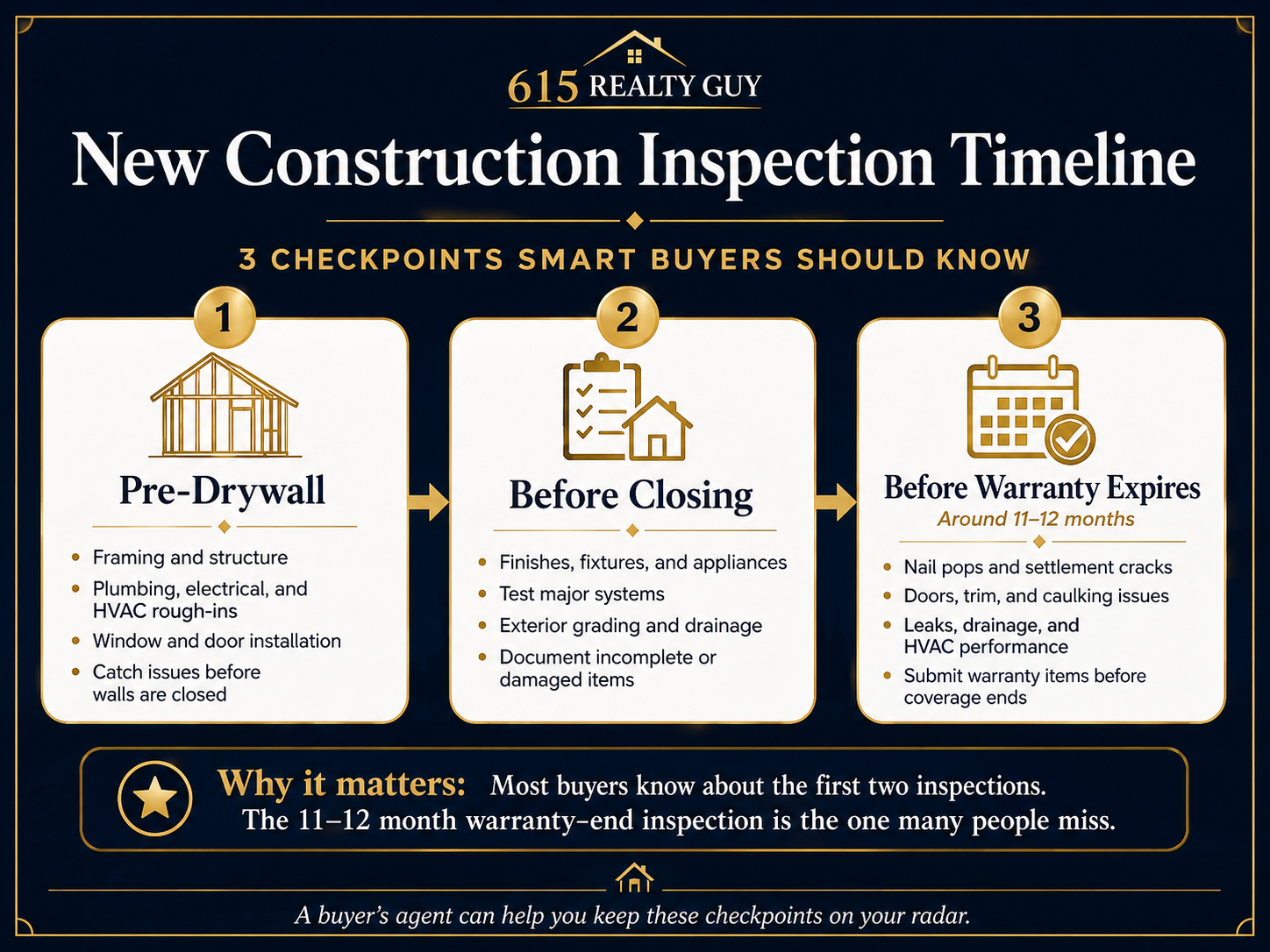
The right inspection cadence on new construction is typically three checkpoints: pre-drywall, before closing, and again before the builder’s one-year warranty expires. That last one is the one most buyers forget — and it’s the most valuable, because it’s your last shot to get the builder to fix things on their dime.
Speaking of new construction details that get overlooked, the post on landscaping new construction homes walks through the lot-side issues — drainage, sod, irrigation, and tree planting — that often need attention right after closing. That’s another place a buyer’s agent should be flagging questions before you sign.
5. Timelines Will Shift
Every new construction timeline I’ve ever been involved in has moved. Weather, labor, materials, utility connections, permitting backlogs, inspection scheduling, builder workload — all of it can slide the closing date.
That matters more than it sounds. If you’re:
- Selling a current home
- Relocating from out of state
- Ending a lease
- Locking a rate
- Coordinating movers
- Enrolling kids in a new school district
…then a four- or six-week shift in closing can cascade into real problems. Your agent’s job is to keep the timeline visible, push the builder for honest updates, and help you plan for the gap between estimated completion and actual closing.
6. Financing and Appraisal Coordination Gets Tricky
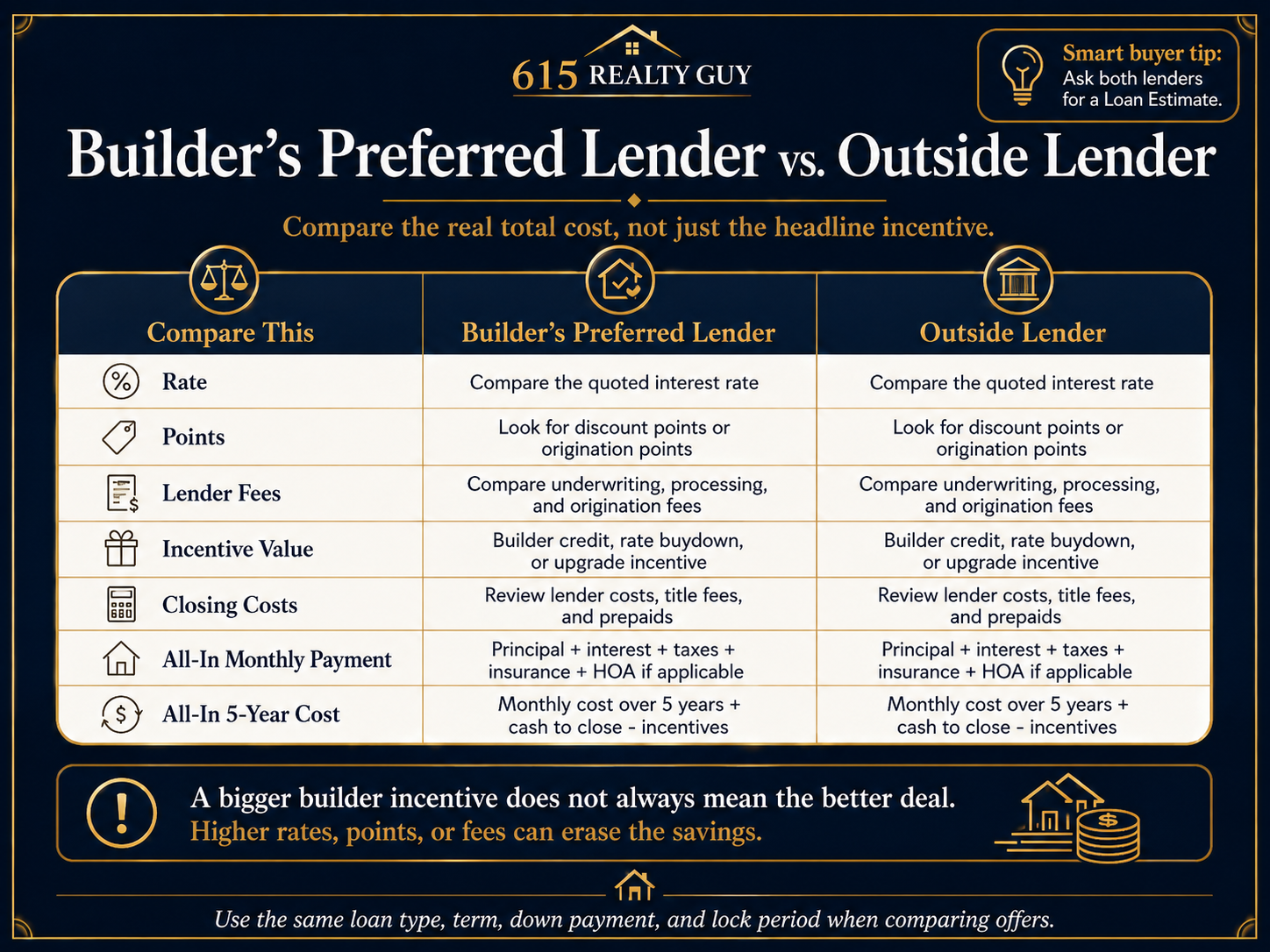
The preferred-lender question is one I get on almost every new construction deal. Builders structure incentives so that the biggest dollar amounts are tied to using their lender. Sometimes that lender is genuinely competitive. Sometimes they’re not.
The questions to actually ask:
- Is the incentive tied to using the builder’s lender, or can you bring an outside lender?
- What rate, points, and fees is the builder’s lender offering — exactly, in writing?
- How long is the rate lock, and what happens if construction is delayed past the lock?
- What’s the appraisal-gap language in the contract?
- Are you comparing apples to apples on loan type, term, points, and closing costs?
- Can the closing date move without penalty if construction slips?
You’d be surprised how often the “incentive” disappears once you do the side-by-side math on lender fees and rate. Other times, the builder’s lender really is the best path. The point isn’t to assume either way — it’s to actually compare.
7. Walkthroughs and Punch Lists Need Follow-Up
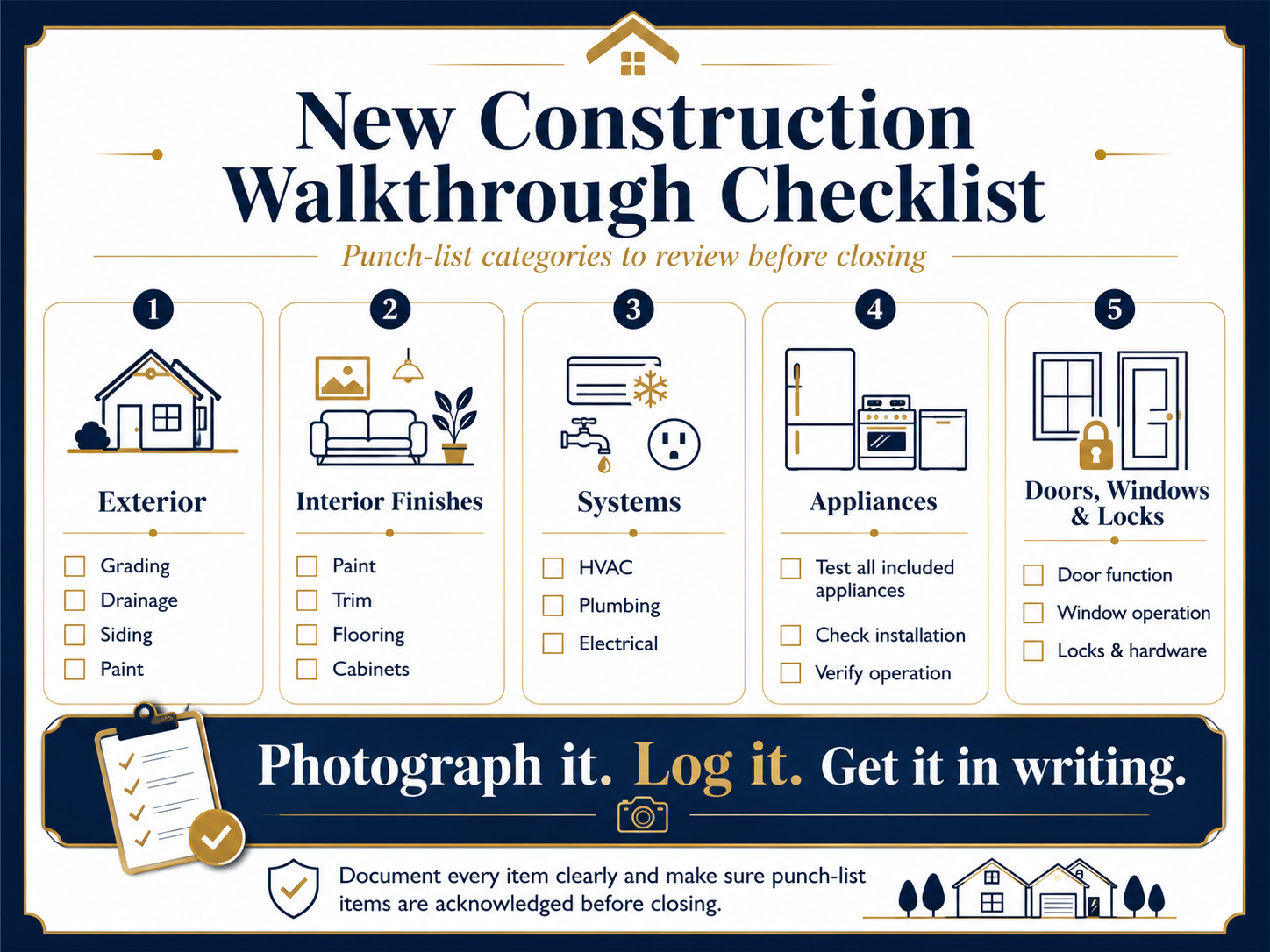
The final walkthrough is one of the highest-leverage moments in the entire transaction. This is where you document everything that’s incomplete, damaged, or wrong — and where you get the builder’s written commitment to fix it.
A good buyer’s agent walks through with you, keeps a list, photographs everything, and makes sure those items end up in writing with a timeline. Then they follow up after closing until each item is genuinely resolved. The builder will fix what’s on the list. Things that aren’t on the list become much harder to negotiate two months later.
When Should You Bring Your Agent? Before the First Visit.
This is the single biggest mistake I watch new construction buyers make: walking into a model home without their agent, getting their information collected by the builder rep, and then trying to add their agent later.
Most builders in Middle Tennessee have agent registration policies. The rule is usually some version of: your agent has to register you on or before your first visit. If you walk in alone, the builder may refuse to recognize your agent on the deal — which means no buyer representation through the rest of the purchase.
That’s a permanent decision made by accident.
The fix is simple: talk to your agent before you start visiting communities. Most of the time I’m registering clients with builders by email or in person on the first walk-through, and the whole thing takes five minutes. If you’re shopping multiple builders across White House, Portland, Gallatin, Hendersonville, and the surrounding markets, those registrations add up — and they matter.
Do You Have to Pay Your Agent Out of Pocket?
Not necessarily.
Under current buyer-representation practices, every buyer should expect to sign a written buyer-agent agreement that spells out services and compensation up front. NAR’s consumer guidance is clear on two things: compensation is fully negotiable, and the agreement has to define it in writing before you start touring with that agent.
In new construction specifically, many builders still offer compensation to a buyer’s agent as part of their sales structure. Others have shifted to different models. The arrangement varies by builder and even by community. The important part is that you and your agent talk through it before you start touring, so there are no surprises when the contract gets drafted.
That conversation should cover:
- What services your agent is providing
- How the agent is being compensated (by you, by the builder, or some combination)
- What happens if the builder doesn’t offer agent compensation on a particular property
- Whether you can negotiate seller-side concessions to cover or offset agent fees
Done well, this is a straightforward conversation that takes ten minutes. Done poorly — or not at all — it becomes a much harder conversation at the closing table.
A Local Note for Buyers North of Nashville
New construction north of Nashville is a different conversation than new construction in, say, Franklin or Brentwood. The towns I cover — White House, Portland, Gallatin, Hendersonville, Springfield, Goodlettsville, Greenbrier, and Cottontown — each have their own builder mix, lot inventory, and price tiers.
A few things I’d want a buyer to understand before picking a community:
- Lot position and orientation. Subdivision lots in the I-65 corridor vary widely. Backing up to greenspace vs. backing up to the next phase’s construction zone is a real difference in value and quality of life.
- Community phase. Buying in phase one is different from buying in phase three. Earlier phases sometimes have better lots and lower base pricing, but you’re living through construction for a year or two. Later phases trade those lots for a more finished community.
- HOA structure and dues trajectory. Read what’s actually included, what’s planned, and how dues can change.
- School zoning. Robertson, Sumner, and northern Davidson County schools are not interchangeable. For families, this should drive the search — not the other way around.
- Resale outlook. What floor plans, lot positions, and finishes will the next buyer want in this community in five to ten years?
- Builder reputation. Some builders in the area are excellent. Some are fine. A couple aren’t. That’s local knowledge that doesn’t show up in marketing material.
- What’s planned within a mile. A new road project, school site, retail center, or competing subdivision can change a property’s value in either direction within a few years.
For ZIP-level numbers behind the towns above, the local market reports I publish are built for exactly this — see White House 37188, Portland 37148, Gallatin 37066, or the broader Robertson County and Sumner County reports.
For relocation buyers coming in from out of state, new construction often looks like the cleanest option early in the search — and it can be the right choice. But the cleanest option isn’t the same as the cleanest decision. Spending real time in each town before signing a contract is almost always worth it.
Bottom Line
You can buy a new construction home in Middle Tennessee without your own real estate agent. Lots of buyers do.
But the builder has representation. You should strongly consider having representation too.
A buyer’s agent reviews the contract, evaluates incentives against your alternatives, compares communities honestly, coordinates inspections, monitors timelines, asks better financing questions, and stays focused on your interests from the first model-home visit through the final walkthrough — and into the warranty period after that.
When you’re making one of the largest purchases of your life, “saving” on representation usually isn’t a savings at all. It just means giving up the person whose job is to look out for you.
If you’re thinking about new construction anywhere in White House, Portland, Gallatin, Hendersonville, Springfield, Greenbrier, Cottontown, Goodlettsville, or the surrounding north-of-Nashville markets — talk to me before you visit a model home. That’s a conversation I have all day, and it doesn’t take long.
You can book a consult, reach me at (615) 491-1638, or read more about how I work with buyers.
Sources: NAR Consumer Guide to Written Buyer Agreements, Tennessee Code § 62-13-405 on agency disclosure, Greater Nashville REALTORS® Market Data Monthly, Realtor.com — Buying New Construction, Zillow — Working with a Builder’s Agent, FRED — Building Permits, Nashville-Davidson–Murfreesboro–Franklin MSA.
